- 1. Alzheimer’s Disease and Cognitive Decline
- 2. Hereditary Breast and Ovarian Cancer
- 3. Familial Hypercholesterolemia
- 4. Lynch Syndrome and Colorectal Cancer
- 5. Iron Overload Disorders
- 6. Certain Cardiovascular Conditions
- 7. Rare Inherited Disorders That Often Go Undetected
- Why Genetic Screening Is About Risk, Not Prediction
- Conclusion
- References
While traditional medical care often focuses on diagnosing and treating illness after symptoms appear, genetic screening offers another layer of insight by helping people understand certain health risks before they become serious concerns.
It’s important to note that genes aren’t destiny. Lifestyle, environment, and other factors all play significant roles in long-term health outcomes. However, genetic screening can provide valuable information that helps individuals have more informed conversations with healthcare professionals and make proactive decisions about their health.
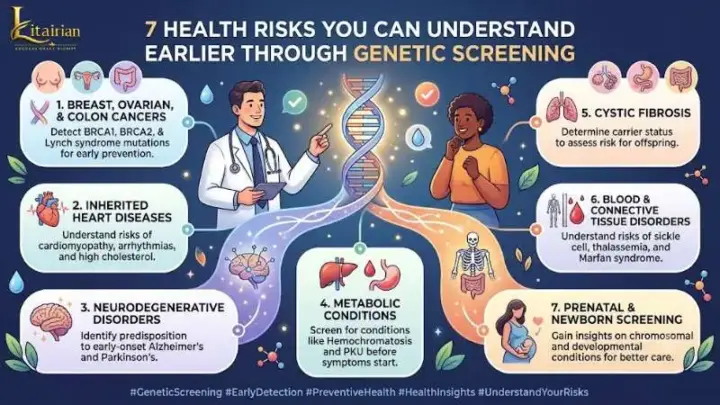
Here are seven health risks that genetic screening may help you understand earlier.
1. Alzheimer’s Disease and Cognitive Decline
One of the most widely discussed areas of genetic screening involves Alzheimer’s disease risk.
Researchers have identified several genes associated with Alzheimer’s, including the APOE gene. Specifically, the APOE-e4 variant is considered the strongest common genetic risk factor for late-onset Alzheimer’s disease. People who inherit one copy of APOE-e4 have an increased risk of developing Alzheimer’s, while those who inherit two copies face a substantially higher risk. However, carrying the gene doesn’t guarantee that someone will develop the condition.¹
Some people choose to undergo APOE genotyping to learn whether they carry the APOE-e4 variant. Tests such as those offered by Fenix Health Science can identify whether a person carries this genetic marker. However, major genetics organizations caution that APOE testing has limited predictive value for asymptomatic individuals because many carriers never develop Alzheimer’s disease, while some patients with Alzheimer’s do not carry APOE-e4. The results should therefore be interpreted alongside family history, lifestyle factors, and guidance from a qualified healthcare professional.
For many people, this information becomes a starting point for discussions about lifestyle habits associated with cognitive health, including exercise, sleep quality, cardiovascular health, and nutrition.
2. Hereditary Breast and Ovarian Cancer
Few genetic discoveries have received as much public attention as BRCA1 and BRCA2. Mutations in these genes can significantly increase the lifetime risk of breast and ovarian cancer. According to the National Cancer Institute, people who know they carry harmful BRCA mutations may be able to work with healthcare providers on enhanced screening strategies and risk-management plans.²
Genetic screening can be particularly valuable for people with strong family histories of breast, ovarian, pancreatic, or prostate cancer. Understanding inherited cancer risk earlier may help individuals make more informed decisions regarding monitoring and preventive care.
3. Familial Hypercholesterolemia
High cholesterol is often associated with diet and lifestyle, but genetics can also play a major role. Familial hypercholesterolemia (FH) is an inherited condition that causes elevated LDL (“bad”) cholesterol levels from birth. Left untreated, it can significantly increase the risk of premature heart disease.
The Centers for Disease Control and Prevention (CDC) recognizes familial hypercholesterolemia as one of the most important inherited conditions for genomic screening because early identification can lead to interventions that help reduce cardiovascular risk.³
Many people with FH are unaware they have the condition until a serious cardiovascular event occurs. Genetic screening may help identify risk much earlier.
4. Lynch Syndrome and Colorectal Cancer
Colorectal cancer is one of the most common cancers worldwide, but some cases are linked to inherited genetic mutations.
Lynch syndrome is caused by mutations in genes responsible for repairing DNA errors. The CDC recognizes Lynch syndrome as a Tier 1 genomic application for family-based genetic testing because identifying affected individuals and their relatives can enable earlier surveillance and risk management. People with Lynch syndrome face increased risks for colorectal cancer as well as several other cancer types.
Genetic screening can help identify these inherited mutations before cancer develops. This information may allow healthcare providers to recommend more personalized screening schedules and preventive strategies for both patients and their family members.
5. Iron Overload Disorders
Hereditary hemochromatosis is a genetic condition that causes the body to absorb too much iron from food. Excess iron can accumulate in organs such as the liver, heart, and pancreas, potentially causing long-term damage if left untreated.
The challenge is that symptoms often develop gradually and can resemble many other conditions, including fatigue and joint pain.
Current recommendations generally support genetic testing for close relatives of individuals diagnosed with hereditary hemochromatosis rather than population-wide screening. Early awareness allows healthcare providers to monitor iron levels and intervene when appropriate.
6. Certain Cardiovascular Conditions
Heart disease remains a leading cause of death globally, and genetics can contribute to risk in several ways.
In addition to familial hypercholesterolemia, genetic screening may identify inherited variations associated with conditions such as cardiomyopathies, arrhythmias, and other cardiovascular disorders.
While genetic results should never be interpreted in isolation, they can provide useful context alongside family history, cholesterol levels, blood pressure readings, and other health indicators.
Growing public interest in consumer genetics has increased awareness of how inherited factors contribute to cardiovascular risk. Companies such as Fenix Health Science are part of a broader trend that has made genetic information more accessible to consumers. For people with relatives who experienced early heart disease or sudden cardiac events, genetic insights may support more informed healthcare discussions.
7. Rare Inherited Disorders That Often Go Undetected
Many genetic conditions remain undiagnosed for years because symptoms are either subtle or mistaken for more common health issues.
Examples include inherited conditions such as Marfan syndrome, certain muscular dystrophies, and metabolic disorders like phenylketonuria (PKU). In many cases, earlier diagnosis allows patients to access monitoring, treatment, or lifestyle modifications that can improve long-term outcomes.
Genetic screening can sometimes help shorten what researchers call the “diagnostic odyssey” – the lengthy process many patients experience while searching for answers.
In some cases, earlier identification can lead to better symptom management, more targeted monitoring, and improved quality of life. As genetic testing technology becomes more accessible, companies, including Fenix Health Science, are contributing to broader public engagement with genomic health education and awareness.
Why Genetic Screening Is About Risk, Not Prediction
One of the biggest misconceptions about genetic testing is that it predicts the future. In reality, most genetic screening provides information about risk rather than certainty.
Genetic risk is only one part of the health equation. Environmental exposures, lifestyle habits, socioeconomic factors, and access to healthcare all influence whether a disease develops over time. This is why genetic screening is best viewed as a tool for understanding risk rather than predicting outcomes.
This distinction is important. Many people with elevated genetic risk never develop the conditions associated with those genes, while others with no known genetic markers may still experience disease.
Genetic screening works best when viewed as one piece of a larger health picture that includes lifestyle choices, medical history, environmental factors, and regular healthcare assessments.
Conclusion
The growing field of genetic screening is helping shift healthcare toward a more proactive model. While genetic information cannot predict every outcome, it can provide valuable insights into potential risks long before symptoms appear.
From Alzheimer’s disease and hereditary cancers to cardiovascular conditions and rare inherited disorders, genetic screening offers an opportunity to better understand factors that may influence long-term health.
For many people, the greatest value lies not in predicting what will happen, but in gaining information that supports better-informed decisions, earlier conversations with healthcare providers, and a more personalized approach to wellness.
References
- Alzheimer’s Association. “Genetics of Alzheimer’s Disease.”
- National Cancer Institute. “BRCA Gene Changes: Cancer Risk and Genetic Testing.”
- CDC Office of Genomics and Precision Public Health. “Tier 1 Genomic Applications.”
- Centers for Disease Control and Prevention. “Lynch Syndrome and Genetic Testing.”
- Cleveland Clinic. “APOE Gene Test: What It Is, How It Works & Results.”
- Nature Reviews Neuroscience. “Apolipoprotein E in Alzheimer’s Disease Trajectories and the Next Frontiers.”

About The Author: Sharat Sir
About The Author: Sharat Sir
His spiritual journey of this birth started in 1995 with awakening and practicing Kundalini Yoga under the guidance of a Secret Himalayan Monk. His healing journey started on May 23, 1997, with Reiki level 1 and till today he has mastered and is attuned to 55 different energy modalities. In the year 1999, he stepped into holistic and spiritual teachings, taught all the therapies he knows to innumerable people, and he is teaching many more now. He has a special ability to attune himself or any one to any energy modality much more efficiently than an actual master can, even without having previous attunement or knowledge. He can see and access cosmic energies for the benefit of mankind. He can see the aura of a person and know which word, mantra, or energy can help the person in his/her desire. Since 1999 he has been teaching and working selflessly, only for the betterment of mankind.