Most people treat sleep like downtime. In longevity science, sleep is the nightly repair window when your brain clears metabolic waste, your endocrine system recalibrates appetite and glucose control, and your immune system rebalances inflammatory tone. In Litairian language, it is also when your field is most receptive. If you want real-world performance and long-term vitality, you do not just “sleep more.” You build a repeatable sleep architecture that your nervous system learns to trust.
Chronic short sleep is consistently associated with higher cardiometabolic risk, and large population studies show a U-shaped relationship where both very short and very long sleep correlate with worse outcomes. The practical takeaway is simple: protect a stable, high-quality 7 to 9-hour sleep opportunity, then optimize what happens inside it.
The Core Mechanism: Circadian Stability Beats Hacks
Your circadian system is not a mindset. It is biology. Light timing, meal timing, activity timing, and temperature cues set the clock that controls melatonin release, cortisol rhythm, and peripheral clocks in organs like the liver and pancreas. When those clocks drift, you can feel it as cravings, anxiety, shallow sleep, and low morning drive.
From an energy perspective, circadian stability functions like a boundary. It tells your system when to receive and when to restore. This is why many people feel “spiritually open but physically drained.” The field is sensitive, but the body’s clock is chaotic.
Anchor light in the first hour, dim light in the last two
Morning outdoor light is the strongest signal for circadian alignment. You do not need perfection, but you do need consistency. Pair that with the opposite cue at night: reduce bright light exposure in the final two hours before bed, especially overhead lighting. Even modest evening light can delay melatonin onset in many people, making you feel sleepy later and fragmenting deep sleep.
Protect the caffeine cutoff like a sacred rule
Caffeine’s half-life in adults is commonly around 5 hours, and it can be longer depending on genetics, stress load, and medications. That means a mid-afternoon coffee can still be meaningfully active at bedtime. If you want better deep sleep and fewer 3 a.m. wake-ups, set a hard caffeine cutoff and treat it as part of your practice, not a restriction.
Make the Bedroom a Repair Signal, Not a Stimulation Zone
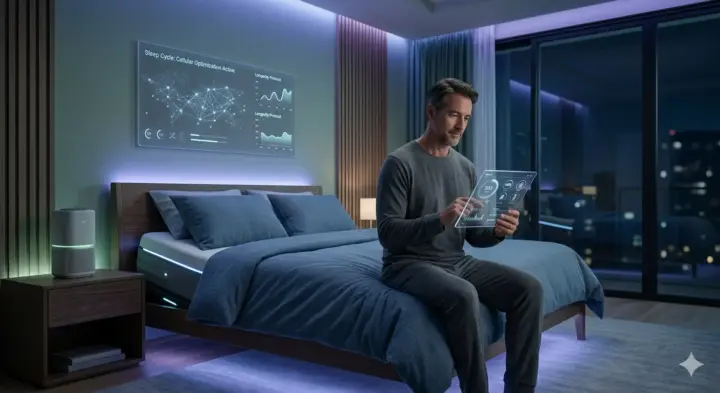
Longevity is not only about what you add. It is also about what you remove. The bedroom should cue parasympathetic dominance: cool, dark, quiet, and predictable. Temperature matters because core body temperature needs to drop for sleep onset and deep sleep continuity. Many people do best with a slightly cooler room and warm feet, which encourages heat dissipation.
If you resonate with VK-style healing and Vastu, think of the bedroom as a directional amplifier. Less clutter, calmer visuals, and cleaner air are not aesthetic choices. They are nervous system instructions.
In the middle third of your week, you may also be managing training aches, old injuries, or connective tissue irritation that disrupts sleep. That is where some people explore recovery tools alongside sleep fundamentals, including peptides, though evidence quality varies by use case, and human data is still evolving. If you choose to go that route, do it thoughtfully and do not let it replace sleep architecture. Some readers ask where to buy BPC-157 online.
Layer a “downshift ritual” to exit performance mode
A ritual is not fluff. It is patterning. The brain learns sequences. Build a 10 to 20 minute downshift that you repeat nightly: low light, phone out of the bedroom, and a simple breath cadence. One of the most reliable is extending the exhale, which nudges vagal tone upward. You are teaching your body that the day is complete and the repair window is safe to enter.
Metabolic Sleep: Stop Waking Up at 3 a.m.
The classic 3 a.m. wake-up often has a metabolic signature: late alcohol, late heavy meals, unstable blood sugar, or stress hormones rising early. Alcohol may help you fall asleep, but it reliably fragments sleep later in the night and reduces next-day readiness. Late meals can also impair sleep by increasing core temperature and digestive activity when your body wants to cool and slow down.
If your nervous system is already loaded, add spiritual sensitivity on top, and you can get the sense that you are “picking up” information at night. Sometimes you are, but very often it is physiology speaking first.
Time your last meal to support deeper sleep
Many people sleep best when the last substantial meal ends at least 2 to 3 hours before bed. If you train hard or run lean and tend to wake early hungry, a small, simple evening snack may work better than a huge dinner. The goal is stable, not strict.
Track one marker: morning energy or HRV trend
You do not need to quantify everything. Choose one signal you trust, like morning energy, resting heart rate, or an HRV trend if you wear a tracker. Look for patterns, not perfection. If your sleep is improving, you should notice fewer cravings, steadier mood, and better training tolerance within weeks.
Litairian Integration: Let Sleep Be Your Nightly Healing Session
At Litairian, Team Litairian often speaks about transformation through consistent practice, whether through energy tools, Healing Clouds, or sessions guided in the spirit of Sharat Sir’s teachings. Bring that same consistency to sleep. Before bed, set a single sentence intention that is body-based, not abstract: “Tonight, my nervous system repairs.” Keep it calm and specific.
Longevity is built in nights, not in motivational bursts. When your circadian cues are clean, your room signals safety, and your metabolism is not spiking at midnight, sleep becomes more than rest. It becomes restoration you can feel in your joints, your cognition, your mood, and your presence the next day.

About The Author: Soham Kumar
About The Author: Soham Kumar
Hi! I'm Soham Kumar, a dynamic 21-year-old individual with a passion for exploration, creativity, and wellness. As an avid traveler, I seek adventure in discovering new cultures and cuisines, enriching my life with diverse experiences. My love for staying fit not only fuels my physical well-being but also embodies my commitment to a healthy lifestyle. With a keen eye for design and innovation, I excel as a website designer, crafting digital spaces. As a professional tarot card reader, I tap into the mystical realms to offer guidance and insight to those seeking clarity and direction in their lives. Beyond my digital endeavors, I am also a skilled cricketer, having showcased his talent in various clubs across Delhi. I am inspiring others to embrace life's adventures with open arms.